

Establishing an Independent Business Valuation During a Shareholder Dispute
When two shareholder groups hold two irreconcilable numbers, the answer is not a third opinion – it is a better process.
Engagement Snapshot
The Dispute
Two branches of a promoter family had jointly owned and run a successful manufacturing business for decades. When the branches decided to separate – with one continuing to run the company and the other exiting through a buyout of its shareholding – the relationship held together on everything except the one question that mattered: what the business was worth.
The exiting group's advisors put equity value at a figure roughly two-thirds higher than the continuing group's number. Neither figure was dishonest; each was an advocacy valuation – built from the assumptions most favourable to its side.
With no shared factual foundation, every discussion collapsed into assertion against assertion. Before the positions hardened into formal proceedings, the two groups agreed to jointly appoint an independent valuer, with both sides committing to a common process.
The challenge was not to find a number between the two positions. It was to establish a process capable of producing one number both sides could understand and defend.
Five Disagreements, One Company
The difference between the two valuations could be traced to five specific questions. Each was legitimate on its face – and each required evidence rather than preference to resolve.
Future Growth
The exiting group projected aggressive growth based on a strong order book and planned capacity addition. The continuing group pointed to near-term capacity constraints and intensifying competition.
Profitability
One side viewed recent margin pressure as structural; the other considered it temporary. Family remuneration and related-party arrangements further complicated assessment of maintainable profitability.
Assets
The company owned land beyond its operating requirements. One valuation recognised current market value separately while the other effectively retained those assets at book value within the business.
Discount Rates
One side applied a rate more typical of a stable listed company; the other incorporated significant additional risk premia. The rate difference alone accounted for a material portion of the valuation gap.
Business Risks
Customer concentration, dependence on family members in key positions and potential operational disruption from the separation were emphasised differently by each shareholder group.
The Independent Process
Our role was not to average the two numbers or arbitrate by splitting differences. It was to replace two advocacy valuations with one evidentiary valuation.
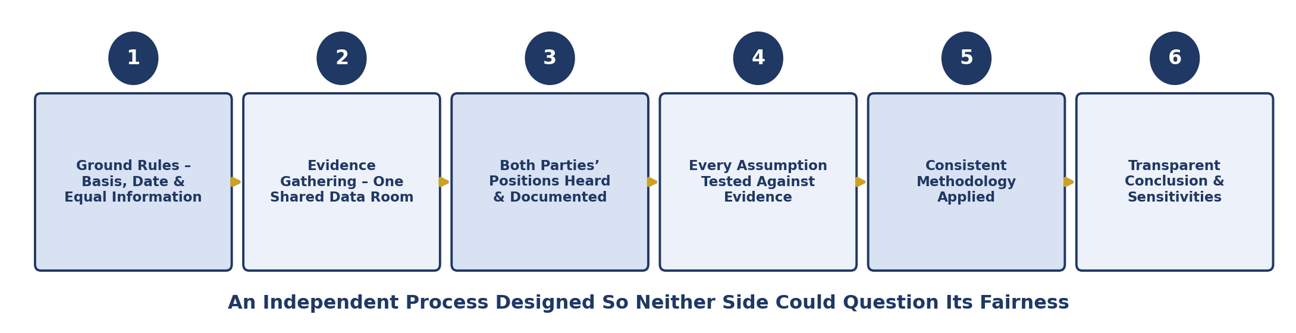
Ground Rules Before Numbers
Before any analysis began, the valuation framework was fixed in writing with both shareholder groups.
This covered the valuation date; the agreed basis of value; one shared data room; joint management sessions so neither group briefed the valuer privately; and a protocol requiring each side's contentions to be submitted in writing together with supporting documents.
Those ground rules did as much to resolve the dispute as the valuation itself, because the conversation changed from "whose number?" to "whose evidence?"
Analysing the Evidence
Documents over assertions.
Growth
Order books, capacity utilisation data and customer contracts were examined to determine what level of future growth could actually be supported.
Profitability
Multi-year audited financials were analysed and normalised using documented principles for family remuneration and related-party arrangements.
Surplus Assets
Title documents, land-use status and independent market evidence were reviewed to distinguish operating assets from assets held beyond the needs of the business.
Risk
Customer concentration, organisational records and the terms of the separation were assessed to determine how company-specific risks should be reflected in the valuation.
Incomplete Evidence
Where evidence remained incomplete, the limitation and the treatment adopted were disclosed explicitly rather than being buried inside the conclusion.
What the Evidence Supported
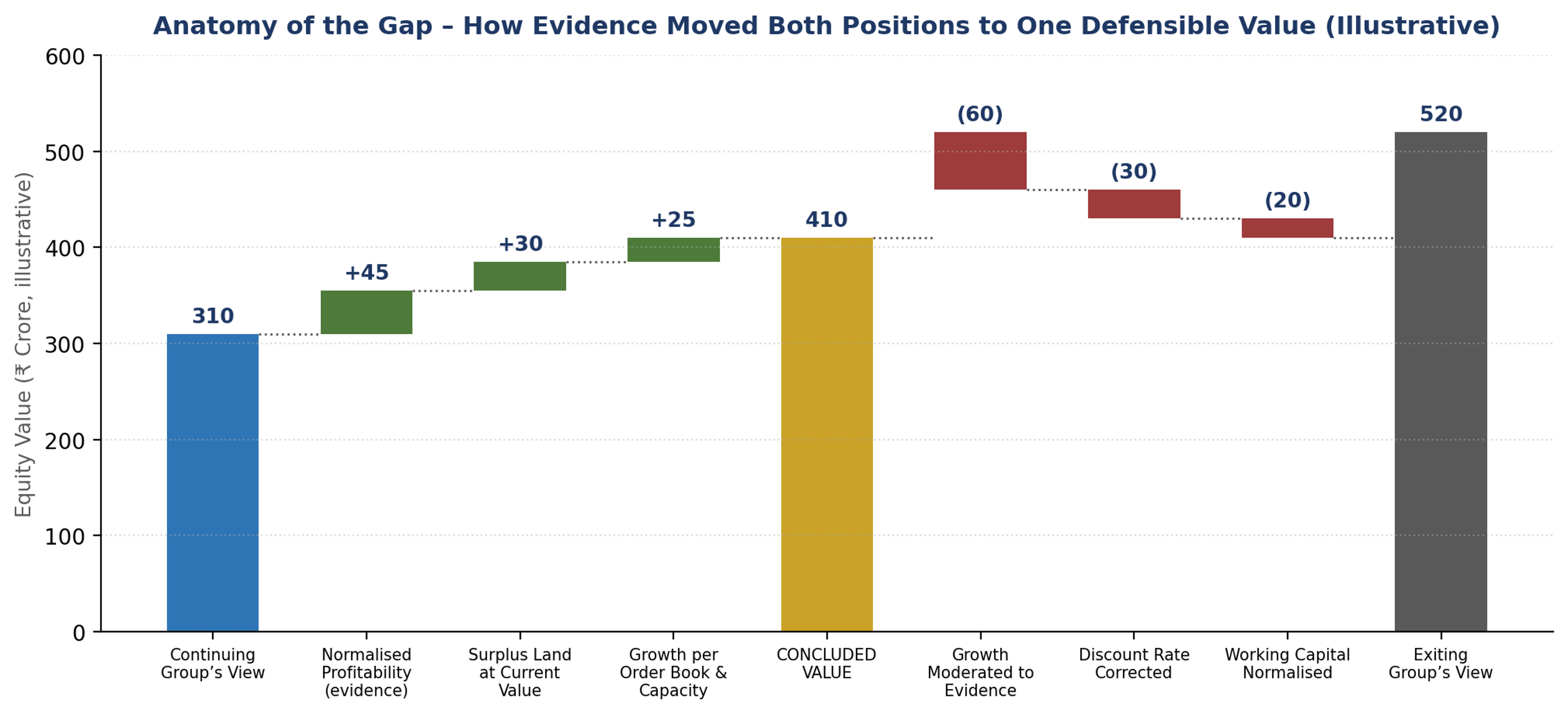
The evidence moved both positions – one of the clearest indicators that the process was genuinely independent.
Growth
Growth was concluded above the continuing group's forecast because the order book and commissioned capacity supported more than its projection – but below the exiting group's case, which assumed flawless execution of expansion that had not yet begun.
Profitability
Maintainable profitability increased after family remuneration and related-party terms were normalised to arm's-length levels, but remained below historical peak margins that the current pricing environment no longer supported.
Surplus Land
Surplus land was separated from the operating business and added at an independently supported current value.
Discount Rate
The discount rate was rebuilt from market inputs with each company-specific adjustment individually justified. The resulting rate fell between the two original positions, but was derived rather than negotiated.
Business Risk
Risks were incorporated where economically appropriate – customer concentration within projections and rate, and key-person dependence within transition assumptions – explicitly and without double-counting.
A Transparent Framework
Showing the working, not simply presenting a number.
The concluded value was developed using a Discounted Cash Flow analysis based on the evidence-supported projections, corroborated using market multiples of comparable companies, with surplus assets valued separately.
The report quantified the value impact of every disputed assumption, allowing each shareholder group to see exactly why the concluded value differed from its position and by how much.
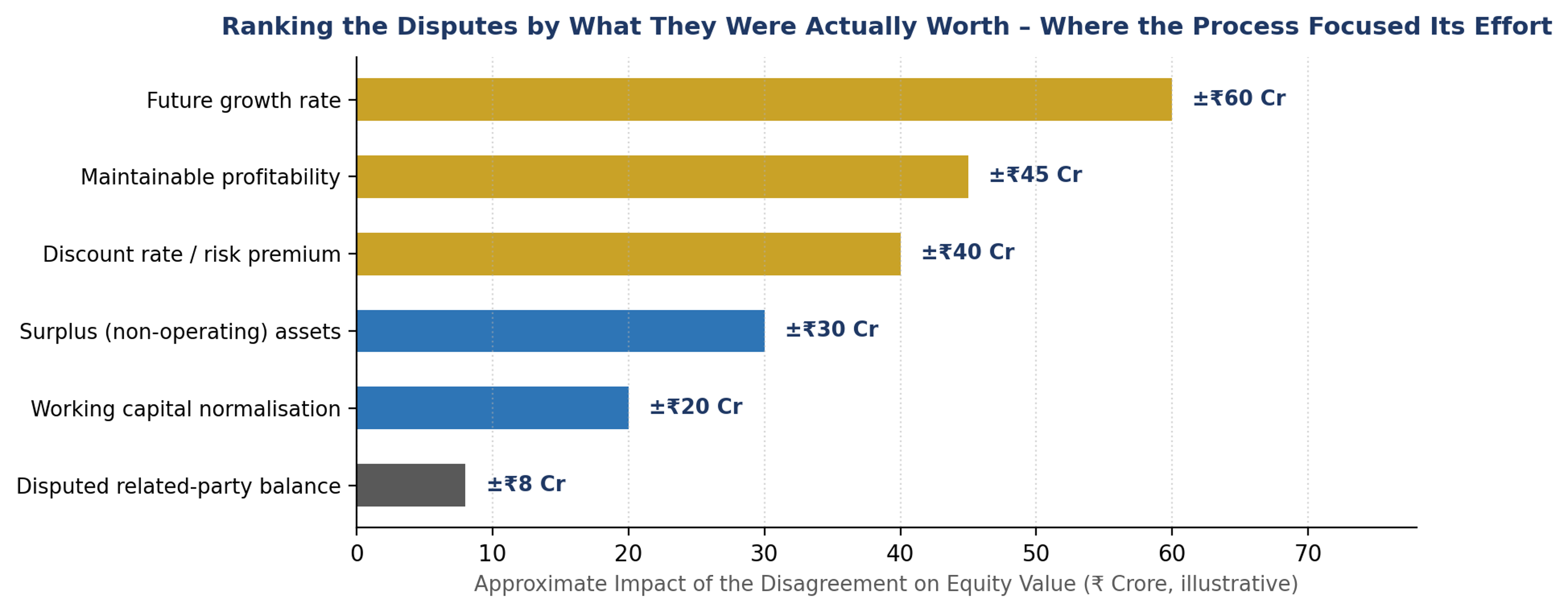
Sensitivity analysis also ranked the disagreements by materiality. Some heavily contested assumptions had relatively little effect on value, while a smaller number of issues accounted for most of the difference.
Both shareholder groups received the draft simultaneously for factual-accuracy review under the agreed protocol. Substantive valuation judgments remained entirely independent.
The Outcome
The independent valuation gave the two shareholder groups what eighteen months of negotiation had not: a single, evidence-based value whose derivation both could inspect, challenge and ultimately accept.
The buyout of the exiting branch was concluded by agreement on the basis of the valuation, and the separation proceeded without escalating into formal proceedings – preserving both the business and, in meaningful measure, the family relationships around it.
Neither side received its number. Both received something more durable: a value they could explain to their family, advisors and financiers because every rupee traced back to an assumption supported by evidence.
Key Takeaways
In a dispute, the process is the product.
Agreed ground rules, one data room, joint sessions and documented contentions convert disagreement from argument into evidence.
An independent valuation is not an average.
Splitting the difference rewards whichever party anchored furthest from reality. Independence requires testing each assumption against evidence and allowing that evidence to move both sides.
Separate the operating business from balance-sheet surprises.
Surplus assets and family or related-party arrangements can materially distort value unless they are identified and treated separately.
Rank disagreements by materiality.
Quantifying how much each disputed assumption actually changes value focuses attention on the handful of questions that genuinely matter.
Transparency makes the conclusion defensible.
A value that both parties can trace assumption by assumption is capable of being accepted. A number delivered without its working is simply another opinion to argue about.
Need an Independent Business Valuation?
Speak with our valuation team about shareholder disputes, business separations, buyouts and other situations where an independent and defensible value is critical.
Book a Free ConsultationAll client-identifying information has been withheld and all figures shown in the exhibits are illustrative, to maintain confidentiality.